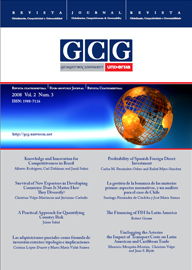
Vol. 2 No. 3 (2008)
Welcome to the fourth issue of the Journal of Globalisation, Competitiveness and Governability in the Latin American Region (GCG)!
This is the third number of the second pack we have published in 2008, and it marks the first anniversary of the journal. In just one year, we can say that the journal has captured not only the attention of Latin American readers, but also readers of a wide range of nationalities. So far, the portal has been accessed from 78 countries, by over 2000 individual users per month. It has also reached a total of 60,000 accumulated page visits and a score of 9 on the 0 - 10 scale Google PageRank™, a visibility and impact tool which counts the number and source of external links received by a website.
Furthermore, and despite its short existence, GCG has been included on a number of select databases. Indeed, it has been added to the LATINDEX catalogue, the Regional Online Information System for Scientific Journals for Latin America, the Caribbean, Spain and Portugal, as it is considered a periodical which meets at least 70% of internationally accepted quality criteria. It should be noted that only 19.86% of Latin American scientific journals are included on this list. The journal is also included on the DICE file (Dissemination and Editorial Quality of Spanish Journals in Humanities, and Social and Legal Sciences), the result of a collaboration agreement between the Spanish National Research Council (CSIC) and the National Agency for Quality Assessment and Accreditation (ANECA). All in all: we can’t complain!
Since the publication of our last issue, the most important event has been the turbulent economic recession which has spread around the world. The startling fall of North American financial markets has spread to the international finance system. This debacle will lead to an economic slowdown which we can expect to effect world economic development. Latin America will not emerge unscathed, although it seems to be better prepared for this crisis than in the past, due to the strong growth seen over the past five years. Indeed, between 2004 and 2008 the average rate of growth was 5.1%. However, Business Monitor International only forecasts 2.8% for 2009. In the opinion of Augusto de la Torre, the World Bank Economist in Chief for Latin America and the Caribbean, the recession will affect each country in the region in a different way. In all cases, some of the effects of the crisis are starting to be felt: financial market crunches and a drop in remittances, the cost of raw materials and demand for exportation.
Indeed, the financial market crunch has inverted capital flow in some countries (e.g. Argentina, Ecuador, Venezuela, Dominican Republic). In the light of reduced remittances, many countries (e.g. Honduras, Nicaragua, Guatemala, El Salvador, Dominican Republic, Mexico) have had no choice but to find alternatives to compensate for the drop in income. The drop in raw material prices, meanwhile, will lead to worse terms of exchange for the region. In the case of a drop in external demand, the worst affected countries will be those which have experienced lower-quality, high risk growth in recent years. Despite everything, Latin America will survive the recession with significant levels of growth, as – thanks to certain measures put in place in recent years – today the region is less vulnerable to macro-financial impact.
In the midst of this crisis, the governments of twenty-two member states of the Latin American Community met in San Salvador at the end of October at the 18th Summit of Heads of State and Government. They agreed to involve young people fully in the dynamics of change and development and undertook commitments to improve education, health, employment and culture. Young people form a generational segment of over 150 million people in the region, and the active involvement of this segment is essential in order to promote innovation, improve competitiveness and drive the economic growth of their countries.
Meanwhile, the leaders of the G-20 countries will attend a summit in Washington DC on 15th November to discuss the current global financial crisis while the city is at the same time preparing to receive the next resident of the White House. This is the beginning of a new era for North American leadership. In the light of this historical electoral victory, the world has reacted with both joy and scepticism, while Latin American anxiously waits for the “promised change” to promote inter-American dialogue, strengthen cooperation and contribute to political and economic development in the region.
In this world context, we publish the fourth issue of our journal. It contains eight articles. In the first, Alberto Rodríguez, Carl Dahlman and Jamil Salmi summarise a recent study completed by the World Bank about innovation as a key contributing factor for increasing the competitiveness of its economy and accelerating growth. Based on field work completed in 2006 and 2007, the authors conclude that the country has not made the best use of knowledge obtained overseas and has neglected to adopt incentives for the private sector to invest in innovation. The article proposed specific actions for promoting innovation between employees and companies.
In the second article, Christian Volpe and Jerónimo Carballo assess the challenges faced by companies in order to survive on the export markets. Using disaggregated databases from Peruvian companies for the period 2000-2006,they establish what type of diversification has best contributed to companies remaining on international markets. The study demonstrates that both geographical diversification and product portfolio diversification increase opportunities; although more so in the case of the former than the latter. The results offer recommendations for the design of appropriate export promotion policies for countries in the region with similar characteristics to Peru.
In the next article, Jaim Sabal presents a financial model for the quantification of country risk. In a highly specific fashion, the article illustrates how to include country risk in the assessment of an emerging market. Traditionally, this is done by increasing the discount rate resulting from using the classic method of evaluating expected return on a capital asset in a developed market, known as the Capital Asset Pricing Model (CAPM) with by a percentage known as “country risk premium”. Additionally, some analysts alter cash flow forecasts to reflect the uncertainty of emerging countries. Sabal maintains that under the method the country risk is factored in twice: in the discount rate and in the cash flow. The article identified the implicit errors arising from the former, and proposes a new method, with a numerical illustration of results, to correct these faults.
In the fourth article, Cristina López Duarte and Marta Mª Vidal Suárez present a theoretical analysis on partial acquisitions as a means of entering a foreign market. They develop a typology which helps to identify the unique features of each type of partial acquisition and to differentiate them from other more frequently-used formulae: the creation of joint companies, establishing wholly-owned subsidiaries or the completion of full acquisitions. Each one of the partial acquisition options is presented with their respective strategic implications and the convenience of using them in different international contexts.
In the fifth article, Carlos Fernández-Otheo and Rafael Myro-Sánchez analyse the profitability of the stock of foreign direct investment (FDI) in Spain by national and overseas companies. The implicit remuneration fees are estimated and analysed for the two main components of foreign investment, capital share and financing between related companies, and for the period 1993 - 2007, in a systematic comparison with other developed countries, after a discussion of some relevant statistical and methodological aspects. Firstly it analyses the temporary dynamics of stocks and income, as a basis for better comprehension of the great change which has taken place in Spain’s international investment position. The main result obtained is a low profitability compared with the assets and liabilities registered in Spain through FDI, which could help to explain the slowing down of flows received in recent years. However, the contrast between the main source of data used and the information taken from the companies in question suggests care should be taken as to the solidity of this conclusion.
In the next article, Santiago Fernández de Córdoba and José María Serena analyse the impact of the increase in raw material prices in Latin American economies, focusing on the case of Chilean copper. In his opinion, this increase represents both an opportunity and a risk, making it essential for the authorities to take action. If price fluctuation is the result of transitory or permanent elements, a sensible response on the part of the authorities should be to ease taxation, to adapt in line with equity or sustainability factors in the growth model. In this context, the authors present a detailed illustration of the response given by Chile which led to an increase in the price of an export product considered transitory and finite.
In the penultimate article, Robert Grosse explains, with numerous examples, the role of Foreign Direct Investment (FDI) as a source of capital. He argues that FDI is often confused with capital flow, rather like a loan from a foreign bank or the issue of an international bond. However, FDI is actually a transfer of control and ownership of a company, which may be financed in different ways (not necessarily requiring a financial flow to the country in question). The financial impact of FDI is rather complex, and the article demonstrates this with specific examples of cases in Mexico, Colombia, Chile and Argentina.
Finally, the eighth article refers to a study prepared by the Inter-American Development Bank on aspects affecting trade in Latin America and the Caribbean (in particular, transport costs and tariffs). In this regard, the authors maintain that a 10% reduction in transport costs would help to increase exportation by 39%, thus exceeding any gains which the region would obtain through reducing tariffs. Without a doubt, high transport costs are a true barrier for trade in the region. As regards methodology, the study combines technical database analysis with the use of specific case studies.