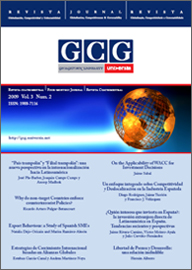
Vol. 3 No. 2 (2009)
This edition of the Journal of Globalization, Competitiveness and Governability continues to comply with the regularity which our readers have come to expect, and with the internationally accepted criteria for quality to ensure it remains at the vanguard. As we have mentioned previously, GCG meets the LATINDEX criteria, meaning that it has been included in its listing of journals and meets the 4 quality criteria subject to continuing assessment by DICE (Dissemination and Editorial Quality of Spanish Journals in Humanities and Social Legal Sciences, run by the National Agency for Quality Assessment and Accreditation (ANECA) and the Spanish National Research Council (CSIC)). Over the course of 2009, GCG has been listed in EconLit (American Economic Association), Ulrich’s Periodicals Directory, and on the Ebsco Publishing Databases.
This edition opens with an article from Professors José Plá, Joaquín Camps and Anoop Madhok, who address, from a theoretical point of view, the concepts of "springboard countries" and "springboard subsidiary" in Spanish-Latin American relations, which despite being continually present on the political and diplomatic agenda have not been analyzed from a management research perspective. They consider a "springboard subsidiary" to be a subsidiary company which converts the localization advantages of the "springboard country" into a true specific advantage for the company. In order to do this, it needs to obtain experience which is relevant (tacitly and specifically), specialized, and more importantly, valued by the parent company and other subsidiaries. This allows it to restore a certain additional level of resources and a greater degree of independence in order to carry out coordination and control tasks and even investment in other subsidiaries.
In the second article, Professor Ricardo Arturo Pulgar-Betancourt analyses how terrorist groups are becoming more complex organizations, capable of making use of the most efficient technology. This creates the need for a transnational counter-terrorism policy in terms of both its resources and its new structures. This article tries to explain why non-target countries want to comply with these regulations. According to this research, target countries search for non-target countries for implementing counter-terrorism policies. Just as a trans-national "market to regulation" is impossible due to transaction costs, this policy is imposed via implicit and/or explicit sanctions, which are applied if the non-target countries fail to enforce the desired level of counter-terrorism.
Professors Natalia Dejo and Marisa Ramirez examine, in the third article, how the behavior of SME´s in the export strategies depends on three main factors: 1) the business sector in which the company works; 2) some of the features of the organization; and 3) the target market. The results obtained show that there are five different export profiles, reflecting the extent of variation in commitment to overseas expansion and the different strategies adopted.
Global strategic alliances, those whose area of work crosses borders, can accelerate the overseas expansion of the company. In the fourth article, Esteban García-Canal and Andrea Martínez-Noya present a detailed analysis of the different fast-track alliance-based overseas expansion strategies. In particular, they present a typology based on the external resources a company needs in order to sell their products to a wider market. For the authors, the main contribution of their work is to show how all types of businesses can benefit from global alliances, independently of their prior available resources.
In the fifth article, Professor Jaime Sabal examines how although WACC (Weighted Average Cost of Capital) may be appropriate for the assessment of projects and business, perhaps it is not the correct rule of thumb for making decisions regarding investment. The reason for this is that it mixes the project itself with tax deductions, meaning that WACC can sometimes "make" unattractive projects seem more acceptable. Investments should only be accepted if they have a positive Net Present Value, less the discount without leverage, i.e. without taking deductions into account. The author considers WACC to be of value only for evaluating the impact of a new project, once accepted, and when the debt rate has been fixed.
In the sixth article, Diego Rodríguez, Jaime Turrión and Javier Velázquez analyze the evolution of competitiveness and the delocalization process of the Spanish manufacturing industry from 1999 to 2006, combining an assessment using aggregate trading data with others using company microdata. The results obtained in the study reveal an unsettling situation in terms of the competitiveness of the Spanish industrial sector, which can be summarized as being that almost 60% of employment in manufacturing is in sectors with serious overseas and domestic competitiveness problems. Finally, in relation to the delocalization process of production activity, the data shows a fall in relevance, primarily when measured on the basis of related employment.
In the next article, the seventh in this issue, Jaime Rivera, Victor Molero and Julio Cerviño search for a valid answer to the question of how to assess the attraction of countries which are candidates for making Direct Overseas Investment (DOI), by studying the three Latin American countries with the largest investment in Spain: Brazil, Mexico and Chile. With the qualitative validation of this new perspective we can determine if it is advisable to consider these countries as potential sources of DOI, or whether new partners should be found. The results suggest that the methodology used in this article is also valid for assessing the attraction of other countries making DOI.
Studies on the relationship between freedom of the press and development date back to the 18th century. However, the meaning of this relationship has not always been interpreted in the same way, and even today it is a topic for debate. Hernán Alberro, in the final article, takes a historical journey through different authors and interpretations, concluding by drawing on empirical data which allows us to observe the reality and the link between these indicators of freedom of expression and development in both the human and the economic aspect.
During the rest of this year we hope you will all continue to trust and support us: members of the Consultative Committee, Editorial Committee, Editors and Associate Area Editors, evaluators, authors and above all, our readers.