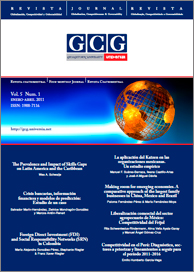
Vol. 5 No. 1 (2011)
The Journal of Globalization, Competitiveness and Governability opens its fifth volume with the regularity our readers have come to expect, and with the internationally accepted quality criteria, audited by LATINDEX (guarantor for scientific quality criteria in Latin America and the Caribbean). GCG has started the year 2011 listed on EconLit (American Economic Association), in Ulrich’s Periodicals Directory; in Ebsco Publishing’s Databases (Business Source Complete); DICE (ANECA-CSIC), etc. and is due to be included on one of the research databases most commonly used by academics: ABI / INFORM Complete (Proquest).
In Latin America and the Caribbean, just as in other regions, it has been detected that many companies and governments are expressing great concern about the shortage of skills and knowledge among workers and how this can limit company performance and efficiency, a phenomenon which has come to be known as “Skills Gaps”. Wes A. Schwalje, from the London School of Economics (UK), analyses the extent of the national skills shortage, and the significance of the lack of qualifications in terms of global business challenges; industries and company size. The article also deals with the consequences of the lack of qualifications in businesses and regional competitiveness.
Given the international relevance of the issue at present, in the second article, Salvador Marín-Hernández (ECIF-CGCEE Consultative Committee, Spain), Zielnice Mondragón-González (University of Sonora, Mexico), and Marcos Antón-Renart (University of Murcia, Spain) analyze, , the financial crisis in Mexico from 1991 to 1996. The authors provide forecasting models which can be applied to any credit institution to indicate its current status. According to the authors, the results of this research show that these models can be used for making predictions.
Maria Alejandra González-Pérez, Stephanie Riegler, and Franz Xaver Riegler, from EAFIT University in Colombia, analyze the relationship between direct foreign investment and CO2 emissions, using a model for Vector Autoregressive Analysis for the period 1970-2005 in Colombia. The article is set in the context of business social responsibility, and presents the socio-political situation in South America since 1980, explaining the consolidation of the social responsibility networks in the region. According to the authors, this research concludes that there is a causal relationship in the Granger sense, of the impact of foreign investment of CO2 emissions in Colombia.
In a turbulent business environment, accentuated by the economic and financial “crisis” of 2008 and 2009, certain organizations in Mexican industry have started to make an effort to improve their operations using different strategies, such as the Kaizen Strategy for Continuous Improvement. For this reason Manuel F. Suáres-Barraza and Ileana Castillo-Arias, from the Technological Institute of Monterrey (Mexico), and José-A Miguel-Dávila, from the Universidad of León (Spain), complete an empirical study to analyze how the Kaizen philosophy is applied in industrial organizations in Mexico; the presence and implementation of the Kaizen principles, techniques and tools; and identifying the possible benefits for tackling a world “crisis”.
The big business giants are an increasing force in emerging economies. Nevertheless, few studies have completed a strict analysis of the high level of family-led control found in many of these giants, and their economic relevance. In the next article, the tutors Paloma Fernández-Pérez and María Fernández-Moya, from the University of Barcelona (Spain), based on an innovative database drawn up on the largest family businesses in Mexico, Brazil and China, identify which are the clans controlling them, and explain their weight and influence.
The next article, by Rita Schwentesius Rindermann, Ángel Gómez Cruz, both from the Interdisciplinary Research Centre for Integral Rural Development at the Autonomous University of Chapingo (Mexico) and Alma Velia Ayala Garay, from the National Institute for Farming and Livestock Research (Mexico) analyses the competitiveness and profitability of kidney bean farming in Mexico. This is done at macro level, between Mexico and the United States, between 1961-2008, and at micro level in the State of Chihuahua for 2005. The authors find that Mexico shows negative competitiveness, due to the overvalued exchange rate favoring importation. The loss of profitability in Mexico, added to the de-regulation of the market, results in kidney beans losing more and more competitiveness compared to this crop in the USA, the country’s main trading partner.
This edition closes with a article by Emilio Humberto Garcia-Vega, from the Pacific University in Peru, which makes a diagnosis of competitiveness in Peru, and proceeds to determine the key sectors in the Peruvian economy, which have greatest potential and positive outlook, meaning that development of these strengthens the country’s future competitiveness. The author offers a closer look to the potential of each key sectors and suggests some actions for improving this country’s competitiveness.
We would once again like to thank all those who make the smooth running of this journal possible: members of the Consultative Committee, Editorial Committee, Editors and Associate Area Editors, evaluators, authors and above all, our readers.
Editor in Chief