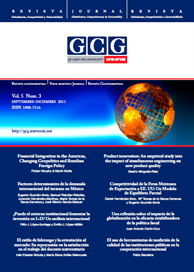
Vol. 5 No. 3 (2011)
The first article in the current edition of the Globalization, Competitiveness, and Governability Journal analyses existing relations between Brazil and the financial markets. Professors Finbarr Murphy and Martin Mullis from the Kemmy Business School at the University of Limerick, Ireland, examined whether stock market participants who invest in Brazil take into consideration the characteristics of a developed nation and the fact that Brazil holds a leadership position in the region. The data presented covers two periods, 1990-1995 and 2005-2010, and demonstrates that attitudes toward Brazil in equity markets were considerably altered during the period of intervention. Using cointegration analysis, the authors empirically demonstrate the “normalisation” of Brazil and the implicit acceptance of its leadership role.
To determine which factors affect the demand for international tourism in Mexico, professors Eugenio Guzmán Soria, Samuel Rebollar Rebollar, Juvencio Hernández Martínez, María Teresa de la Garza Carranza, and José Alberto García Salazar (Instituto Tecnológico de Celaya, Universidad Autónoma del Estado de México, and the Colegio de Postgraduados de Chapingo, México), use a double autoregressive logarithmic model with independent qualitative variables and annual statistics from the period 1980 to 2009. The results indicate that tourism in Mexico responds inelastically to the country’s fluctuations in the cost of living, that it is directly related to the behaviour of economic activity in the Unites States and Canada, and, in terms of the promotional effect, that it is dependent upon tourists who visited Mexico in the previous period.
Professors Feliz J. López Iturriaga and Emilio J. López Millán (Universidad de Valladolid, Spain) analyse the affect of legal protection for investors and the ownership structure in corporate investment in Research and Development. Based on data from 1,091 companies in 19 countries, the authors claim that a legal framework which protects the rights of investors encourages corporate spending on R&D. Once institutional obstacles are removed, financial factors become more effective in generating R&D. The concentration of ownership acts as a substitute for legal protection, and positively influences the R&D of those countries with inferior institutional environments.
In the following article, professors Inés Küester-Boluda (Universidad de Valencia, Spain) and María Elena Avilés-Valenzuela (Centros de Estudios Superiores del Estado de Sonora, México) analyse the relationship between types of leadership and market orientation in the university field, as well as the repercussions of this relationship on job satisfaction for university professors in developing countries. In so doing, the Centro de Estudios Superior del Estado de Sonora (Mexico) was chosen, with its sample of 219 university professors. The results indicate that instrumental and compassionate types of leadership are directly and positively related to market orientation; unlike participatory leadership which, though it has a positive effect, it is not significant. Moreover, the results confirm the existence of a direct and positive correlation between the professor’s market orientation and his/her job satisfaction.
The importance of developing new products in order to remain competitive, as well as product quality as a source of competitive advantage is unquestionable. What is questionable, however, is the traditional practice of the organisation and the execution of the development process. Professor Beatriz Minguela (Universidad Complutense de Madrid, Spain) analyses the impact of a single practice, simultaneous engineering (through its fundamental principles), on the increase of quality in new products. The results seem to indicate that simultaneous engineering may have an influence on quality improvements in new products. Early involvement is the basic principle of simultaneous engineering, which has no effect on the quality of a new product, but the use of multifunctional teams has a major influence on this variable, which represents the success of a new product.
The U.S. is the world’s leading consumer of strawberries, and in order to satisfy demand, large quantities are imported. According to Daniel Hernández Soto, Teresa de la Garza Carranza, and Eugenio Guzmán Soria (Instituto Tecnológico de Celaya, México), the Mexican strawberry represented 99.30 % of the total imported by the US in 2009; while between 1989 and 2009, the average annual level of growth was 9.81%. According to the calculated price flexibility, the authors show that when there is an increase of 30% in the amount exported to the US in a year, the price would drop 2.4715% in the short term. The simulation model shows that the cost/benefit relationship for producers in the Michoacán, Baja California, and Guanajuato would be greater than one (1.42, 1.36, and 1.12 respectively); meaning that it continues to be profitable for strawberry producers in the three States, with a 30% increase in the quantity exported to the US.
Globalisation can profoundly alter the conditions in which fiscal policies are developed. In addition to the relaxation of trade restrictions, governments and other economic agencies now have access to an enormous volume of loanable funds, corresponding to international capital markets; on the other hand, these conditions are fertile ground for a growth trend in public debt. In this context, professor Juan Antonio Cerón Cruz (Universidad Carlos III de Madrid, Spain) tries to answer the question, ‘Is fiscal policy more or less efficient in its management of aggregate demand?’
In order to encourage the implementation of institutional reforms that promote equitable and sustainable economic development in countries receiving aid, several tools to measure the quality of public institutions have emerged in recent years. In the Journal’s final article, professor Pablo Bandeira Greño (Universidad CEU San Pablo, Spain) describes, analyses, and classifies these tools, pointing out the possible benefits they may present for the various international aid agencies.
Again, we would like to thank all of those who make the Journal possible: members of the Advisory Board, the Editorial Board, the editors and associate editors, advisors, authors, and above all, the readers.