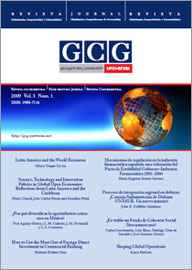
Vol. 3 No. 1 (2009)
Welcome to the fifth issue of the Journal of Globalization, Competitiveness and Governability in the Ibero-American Region!
Since the publication of the last issue there have been significant changes not only for Latin America but for the whole world. First, we witnessed a historic moment with the victory of Barack Obama in the United States Presidential Elections in November. President Obama is now settling into his role as the 44th President of the country and we are beginning to notice the changes. The current economic recession, and the conflicts in Iraq and Afghanistan are priorities which will probably place the Latin American region on the back burner. Although there are common priorities such as drug trafficking (Plan Colombia and Plan Mérida), trade (Free Trade Treaties) and immigration (mainly Mexico), there is still no clear strategy as to how the relationship will stand. Secondly, the recent world economic crisis caught many businesses and countries in Latin America by surprise. As in any crisis, there will always be those who are better prepared to counteract the negative effects forecast by all economists.
Turning to the content of the Journal, and with regard to Globalization, one of the recurring themes that arises when we talk about the successful development of a country is the degree of globalization to be found there. The higher the level of globalization, the greater the benefit for the population from the promotion of overseas trade, and foreign direct investment. According to the latest Latin Globalization Index report, Latin America increased its globalization index during 2008. Obviously, not all Latin American countries benefited in the same way, and some even lost out. According to the Latin Business Chronicle, 13 of the 18 countries included in the study saw an increase in their globalization index. This index measures exports, imports, direct foreign investment, tourism, remittances and internet penetration rates as a percentage of GDP. In 2008, Panama was once again the most globalized country in Latin America. But the country with the greatest progress was Nicaragua, driven by a strong increase in overseas trade. Its exports increased to 45% of GDP and the importation of goods and services rose to 74.5%. It is interesting to observe that the regional giants, Brazil and Mexico, only achieved small advances on this index. Brazil, for example, only exported 14.7% of GDP, compared with 68.3% exported by Panama, while importing only 10.6% of GDP.
The question to ask is: Why is it that the most globalized countries in Latin America are also some of the smallest ones? The answer lies in their open policies which welcome new investments. It is precisely their smaller size which forces them to look outwards in search of new opportunities for their national products. Furthermore, the products and services which these countries cannot produce efficiently are imported in order to meet local demand. The message is clear: the globalization index is yet another testament to the success of free trade. The results are reflected in the economic progress obtained by the leaders of this ranking. These same countries will undoubtedly be in a better position to adapt their economies to the gloomy climate currently sweeping Latin America. Indeed, the expected long-term recession is a strong threat for the region. The world economic crisis has put an end to the growth observed over the past 5 years where the average figure for the region was 5%. The growth rate dropped to 4.5% in 2008 and the most optimistic forecasts for growth are of 1.9% for 2009, according to the Economic Commission for Latin America and the Caribbean.
In terms of Competitiveness, a report from the German Ifo Institute and the Getulio Vargas Foundation in Brazil, presented in América Economía, states that the economic climate in Latin America is the worst it has been in the last 19 years. Latin America entered into recession in October, and the region is currently experiencing the downturn stage, without any significant recovery foreseeable on the short term. Both organizations assess three different indices; the Economic Climate Index, the Present Situation Index and the Expectation Index. The first reached 2.9 points for Latin America in January, its lowest level since the index was started in January 1990. The Present Situation Index also hit its lowest level since October 2002. Finally, the Expectation Index registered a new record low, dropping from 2.5 to 2.3 points. On this index, Latin America remained close to the world equivalent, which registered 2.8 points in January.
This is clearly no surprise, yet it is interesting to see the performance of individual Latin American economies. Upon reviewing the individual results we can see that with the exception of Peru and Uruguay, the economies of the other countries in the region are in periods of recession. For example, depending on the index, Bolivia showed its lowest results since July 2003, and Mexico registers one of the smallest rates in history. Similar results can be found in Brazil, Paraguay and Ecuador. It is unsurprising that the worst current situation is found in the Venezuelan economy.
This analysis shows that for coming months forecasts will remain unfavorable, as the Expectation Index for the region reflects a greater degree of pessimism than those found on average around the world. Both institutions indicate that the combination of optimistic assessments for the present and relatively negative forecasts for the future "can be explained by the fact that Latin America was showing above-average growth during the third quarter of 2008." It is not easy to predict these economic crises, and it is even more difficult to overcome them successfully without adequate planning.
Turning to Governability, we expect important changes to take place in the region. In addition to the results in Ecuador, Bolivia and Venezuela, there are upcoming presidential elections in Chile Uruguay, Honduras, El Salvador and Panama. We do not know what President Obama's position will be towards this region, although some expect more direct diplomacy. In fact, he has used the famous saying by John F Kennedy “Let us never negotiate out of fear, but let us never fear to negotiate.” According to the Inter-American Dialogue, there will be a change in diplomatic style, which will become “less didactic, and more focused on building consensus through multi-lateral organizations.” We will see this in practice next April, when the leaders of the 34 countries of the region will meet in Trinidad & Tobago for the Summit of the Americas, to talk about how to strengthen cooperation. The topic of the Summit is: “Securing Our Citizens’ Future by Promoting Human Prosperity, Energy and Environmental Sustainability.”
This fifth issue of our journal contains eight diverse articles covering the different areas studied by the journal. In the first article, Álvaro Vargas Llosa examines in detail the impact of the world recession on Latin America. The region has lost the equivalent of 60% of GDP! In addition to presenting revealing statistics, the author draws interesting comparisons with the preparation of other world regions in the face of the coming crisis, in particular China or India. The analysis includes an assessment of the different governments of the region, using his now well-known analogy of the vegetarian government and the carnivorous government. The risk posed by the new situation of world economic crisis is that some of the improvements observed over recent years may fade away. Economic growth has been the result of economies being more open than they were in the 1980’s, creating a new middle class in these countries. New income has even resulted in some countries reducing poverty using incentives for education. The article lists, with specific examples, the measures which need to be taken to remain competitive, an indispensable requirement in order to prosper in a sustainable way.
In the second article, Mario Cimoli, João Carlos Ferraz and Analiza Primi present a critical reflection on the challenges faced by Latin America and the Caribbean in terms of investment policies in Science and Technology in the light of the current economic crisis. The world economic crisis highlights the wide gap between developed countries on this level. During the first half of this decade, the region benefited in its growth rate due to commodities trading. However, very little was done to update technology and human capital. The article questions the future of the already weakened industrial and technological policies in the region in these times of crisis. After a brief summary of industrial structure and the demand for knowledge and innovation, the authors describe the four lessons which have been learned in the region. Finally, they offer their reflections on the measures required to strengthen future prospects for the region in the context of this economic crisis.
In the next article, Noé Aguilar Rivera explores the existing options for guaranteeing the survival of the Sugar Industry in Mexico. The sustainability and productivity of the sugar cane farming industry has been questioned, as it is an industry with a high social impact but which does not generally offer development for co-lateral businesses. The fundamental thesis is that there are key economic, social and environmental advantages which justify investment in this industry. However, it is a conflictive industry which has been affected by political elements, and not necessarily by internal production or market factors. It has become necessary for key players in the industry (entrepreneurs, sugar businesses, syndicates, sugar cane producers, goods and service providers, and consumers) to work together in determining a coherent long term strategy. The obvious alternative is diversification towards more innovative sub-products which allow for sustainability of the industry.
The fourth article, by Mehmet Genc, looks at how to obtain the maximum benefit from Foreign Direct Investment (FDI) in Commercial Banking. The influence of Foreign Investment in banking has rapidly accelerated over the past decade, in particular in Latin America and in Eastern European countries. The author analyzes the advantages of the arrival of foreign banks for the efficiency of local banks. Among others, foreign banks contribute to the creation of a more developed and more stable financial system, which in turn contributes to economic growth. The fundamental argument is that restrictions on the entrance of foreign banks and on the activities carried out by these banks leads to a less efficient banking system and increases the cost of loans for those who need them. The article argues that governments should focus on improving the institutional climate and reduce regulations on companies. Regulations which encourage competition and free entrance maximize the positive impact of foreign banking on the efficiency of domestic finance.
In the fifth article, María Eugenia Suárez Serrano analyzes the bases and results of the Government-Pharmaceutical Industry Stability Pact from 2001 to 2004. The purpose of the Stability Pact was to limit the annual increase in public pharmaceutical expenditure in order to create a favorable environment for research. Through a thorough statistical analysis of a sample of 45 pharmaceutical laboratories, complemented with a cluster analysis of the main variable strategic principles of the industry, the author demonstrates that company behavior has indeed remained stable during the period in question.
The sixth article, by John Griffiths, examines the conditions for achieving regional integration in defence. Traditionally, regional integration projects considered dimensions of economics and infrastructure. This article discusses the historical efforts for regional integration, suggesting the establishment of the Union of South American Nations (UNASUR) from the perspective of the South American Defence Council (CSD). In order for this integration to be successful, a State must have a certain level of consolidation that allows it to fulfil the major functions of governability and security. Secondly, it is necessary for the group of States and their territoriesmust present an acceptable level of integration in infrastructure and energy. Finally, all integration efforts in the area of security and defence must be based on an adequate existing level of political integration which allows a consensus on, and the identification of common risks, threats and opportunities. The theory is that any attempt at regional integration of defence will not prosper at the desired pace until these factors are developed in a coherent and organized manner.
In the seventh article, Carlos Garcimartín, Luis Rivas, Santiago Díaz de Sarralde and José Antonio Alonso also discuss integration, but from a financial point of view, and they ask if a Spanish American Social Cohesion Fund is feasible. The ultimate objective of the Fund goes beyond the redistribution of income between members. According to authors, the degree of true integration between Latin American economies is limited, both from a perspective of trade, investment, emigration and macro-economic coordination. The idea is to create a tool which benefits and provides incentives for greater integration in Spanish America and which, ultimately, improves the well-being of citizens. Just like the European Union, there are a great many arguments in favor of this development, but the region has significant obstacles for the creation of a viable fund. Firstly, the level of true integration between Spanish American countries is limited. Secondly, there are no common institutions in Spanish America which can carry out management, supervision and control tasks. Thirdly, if the Fund contemplates co-financing by national or local authorities for diverse projects, the fiscal capacity of many Spanish American countries will be limited. However, considering a range of different financing situations, the total resources available would be between 600 and 800 million dollars, a far cry from those available in the European Union.
Finally, in the eighth article, Kasra Ferdows presents a highly interesting model for conceptualizing the evolution of the management of the production network run by global companies around the world. He argues that the key issue is not where to produce, but where to carry out individual production tasks. Globalization has brought with it the possibility of separating production processes so that components are made in a number of different countries, and final assembly can take place in the target country. This is an interesting opportunity for Latin America, which in view of the world economic crisis, is looking for innovative ways to “add value”, going beyond the sale of commodities (the traditional method). Latin America could be one of the production destinations for some of the processes, in particular for products due to be sold in the United States market. The conceptual model is based on firm examples of four global companies including the specific case of Zara (Spanish clothing firm present around the world).