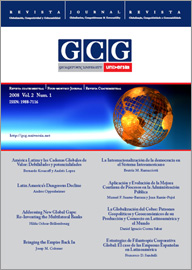
Vol. 2 No. 1 (2008)
Welcome to the second issue of the Journal of Globalization, Competitiveness and Governability in the Latin American Region!
It is clear that the current world situation confirms the impact of the topics chosen for our Journal in the Latin American region. Firstly, globalization can be felt through the force of free trade agreements in the Region. Although the Free Trade Agreement between the US and Peru has been approved, those with Colombia and Panama are still pending. The topics relating to competitiveness become clear in the light of global financial turbulence. At the end of January, in Davos (Switzerland) political and business leaders and academics came together for the Annual Meeting of the World Economic Forum, an organization which through reports such as the Global Competitiveness Report, have a considerable influence over the management of investments and capital around the world. Naturally, the central theme was how to address the negative effects of the financial crisis in the United States and prevent or minimize the spread to other economies. In this regard, although Latin America has had its best ever performance for three decades (growing at an average rate of 5%), the effect of the United States economic lethargy is beginning to show. After an exuberant year on the stock markets, Latin American financial markets could not escape the worldwide knock-on effect and finally stock exchanges in the region fell sharply. Finally, the United States elections and the recent news of Fidel Castro’s retirement, call for reflection on the issues of governability.
This second edition contains eight articles on a range of topics. In the first article, Bernardo Kosacoff and Andrés López discuss the impact of Latin America’s appearance on the global scene, in particular through Global Value Chains (GVC). They conclude that Latin America takes little part, in these, and not in the best way. They consider that joining a GVC is not, in itself, a positive thing in terms of long-term business competitiveness, nor from a national economic development perspective, unless it is combined with other factors. In spite of a few successful cases mentioned here, only a few countries are involved in these chains, and their involvement is at lower, less valuable levels. This, together with a poor national integration, weakens the distributive effects and spillovers into domestic economies, and the impact on development is therefore slight.
In the second article, Andrés Oppenheimer presents an adaptation of his recent book “Saving the Americas: The dangerous decline of Latin America and what the U.S. must do” (Random House, 2007). With his characteristic style, interesting figures and arguments based on interviews, Oppenheimer concludes that Latin America has grown almost exclusively due to external factors, such as the push of global economies and commodity prices. However, these factors will not always be there. While pragmatism and an obsession with the future lie behind decisions taken in Asian countries, Latin America is still held back by ideology, entrenched in the past. During his research, the author traveled to China, India, Poland, the Czech Republic, Ireland, and over ten Latin American countries, in an attempt to understand why some countries grow and reduce poverty more quickly than others. Compared with other emerging regions (Asia, Eastern Europe and even Africa), Latin America is being left behind. The article ends on an optimistic note: although there is still a lot to be done, the region could still surprise the world if economic and political stability is achieved in a democratic context.
In the next article, Hilda Ochoa-Brillembourg offers five recommendations regarding the role to be adopted by International Financial Institutions (IFI), such as the World Bank, the International Monetary Fund and the Inter-American Development Bank, in order to reduce the increasing disparities concerning entry and access to capital markets by the poorest parties. In her opinion, IFIs should separate their financial agency functions from their research activities as thus offer specific actions in both areas. This would allow these institutions to achieve more affective management of their sources of finance and to comply with operational objectives.
In the fourth article, Josep Colomer looks at the difference between State and Empire. After an analysis of relevant literature, he concludes that political sciences would benefit from a broader classification of government structures in distinguishing between empires, states, and communities when it comes to studying traditional issues such as political institutions, the determination of public agendas, voting and election, the operation of parliaments and councils, foreign policies, international relations and international organizations. According to his definition, the world today consists of five large and powerful empires: North America, China, Europe, Japan and Russia. These five political units represent 40 percent of the world’s population and 80 of production. Other units can be considered as empires in terms of size and variety of population. These include Brazil.
The fifth article, "The Internationalization of Democracy in the Inter-American System", by Beatriz Ramacciotti, presents in a details, documented and critical fashion, the evolution of the defense of democracy at international level, linking it to globalization and the technological development of recent decades. This analysis stresses the bases of the democratic paradigm, whose growing consolidation and internationalization at all levels, and in almost all of the world’s societies, is a tangible reality. Meanwhile, it is indisputable that both in Europe and in Latin America, democratically elected governments are the rule and not the exception.
In the sixth article, Manuel Suárez-Barraza and Juan Ramis-Pujol examine the concept of Continuous Process Improvement (CPI) at Government level, based on qualitative research carried out at four Town Halls in Spain. The authors try to uncover the strengthening and debilitating factors which affect the development of the different stages of CPI. Traditionally, studies on CPI have focused on manufacturing organizations in the private sector. This article presents a first attempt to structure this application to the concept in the public sector.
In the seventh article, Daniel Correa Sabat reflects on the geopolitical and geo-economical patterns which influence the globalization of copper in Latin America and the rest of the world. Starting with the example of copper, the author highlights the challenge faced by Latin America in the promotion of foreign investment and the de-regulation of the market as measures for achieving improved integration of the region on the global market and taking more advantage of globalization. In addition to a historical account of the copper strategy in Latin America and the world, the article looks at: reserves and producer countries; global markets; the main producing companies; the globalization of production; international trade; financial markets; and finally the globalization of the copper trade.
Finally, in the eighth article, Franceso Sandulli evaluates global corporate philanthropic strategies through a case study of Spanish companies. These businesses analyze corporate social investments in the same way as they do their financial investments. Taking the companies listed on the Madrid Stock Exchange as a sample, rigorous statistical models are drawn up in order to examine different hypotheses of behavior. The author maintains that companies with a good corporate reputation around the world are more likely to use a standardized social action strategy. Companies tend to align their social action strategy with their international competitive strategies. The different characteristics of each country affect the decision to take social action to international level, but once the company decides to take this step, the particularities of each country do not (statistically speaking) influence the type internationalization strategy applied to social action.