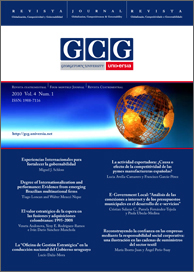
Vol. 4 No. 1 (2010)
With this issue of the Journal of Globalization, Competitiveness and Governability, we commence the fourth volume, faithfully meeting the regularity which our readers have come to expect. This issue opens with an article by Miguel J. Schloss, tutor at the Catholic University of Chile and member of the prestigious Dalberg Global Development Advisors Directory. He questions the legitimacy of the fight against corruption, given its poor effectiveness on the ground. He argues that current initiatives are based on poorly conceived diagnosis and the official organizations lack the agility and independence necessary for tackling the issue. In order to defend his theory, Scholss analyses the causes behind the problems of corruption, empirical evidence and the relevant corrective action. He concludes that action should be complemented with the development and capacitating of civil societies; the strengthening of public administration; the establishment of submission of accounts and mediation mechanisms.
The second article, by Tiago Loncan, a GCL student at Georgetown University, and Walter Meucci Nique from the Federal University of Rio Grande do Sul in Brazil, analyses the relationship between the degree of internationalization (measured by international sales over total sales), and the financial and market performance for five Brazilian multinational companies. The results indicated that greater degrees of internationalization in sales are linked to positive ROA (returns on assets) and Tobin’s Q (market performance).Businesses competing in sectors with a higher aggregate value show marginally greater returns on international sales.
Professor Veneta Andonova, Yeny E. Rodríguez Ramos and Iván Darío Sánchez Manchola, from the University of the Andes in Colombia, analyze the behavior of Colombian businesses in industries characterized by waves of mergers and takeovers between 1995 and 2008. The authors conclude that in terms of profitability, companies following this trend at a later stage have an advantage over those entering this trend in its early stages, three years after the operation. Similarly, the article offers recommendations to managers considering entering the Colombian market via mergers or takeovers.
Is Governability under threat in Latin America?; Have the reforms in Uruguay been beneficial?, Colonel Lucio Dalía Mora from the Centre for Higher National Studies, in Uruguay, attempts to answer these two questions. He believed that the constant uncertainty in our nations results in certain imbalances, such as the inability to think, and the inability to produce and innovate. Strategy, Prospective, Intelligence and Strategic Management, properly coordinated and working smoothly together, mean pro-active measures can be taken to ensure that we are doing the right thing.
The next article, by the tutors from the University of Oviedo in Spain, Lucía Avella Camarero and Francisco Pérez García, analyses the relationship between Spanish small and medium sized business export activity and their level of competitiveness. Using data from the Survey on Business Strategies, the authors examine both whether exports contribute to improved business results, and whether a high level of competitiveness constitutes a requisite for exportation. The evidence gathered shows, on one hand, that business results are slightly improved as a result of commencing exportation - but not after an increase in volume of exports - and, on the other, that good existing results facilitate both the start of exportation and greater overseas presence for our small and medium-sized businesses.
The overall aim of the investigation carried out by Cristian Salazar, C. Pamela Fernández Tejeda and Paula Ubeda Medina from the Southern University of Chile, is to identify the level of development of e-services, in the municipal area of the Los Ríos Region, in Southern Chile. In order to do this, they use a model designed and applied in the municipal context in Spain, which measures this development using the e-Value index. The authors conclude that the number of internet connections and communal cost estimates are not determining factors for the level of development of the e-services under scrutiny.
The global recession has worn away confidence in business and their directors. Maria Iborra Juan, from the University of Valencia, and Ángel Perís Suay from the “San Vicente Ferrer” Faculty of Theology, suggest that the recover of confidence lies in the development of a pluralist business model which assumes local social corporate responsibility. In order to justify this hypothesis, they examine the extend to which this social corporate responsibility is found in supply chains in major Spanish textiles companies, showing the diversity of responses in terms of transparency and participative dialogue. For these authors, transparency and dialogue should lead to the creation of an “ethos” to restore lost trust.
In the coming year we hope to continue receiving the support and trust of all: members of the Consultative Committee, Editorial Committee, Editors and Associate Area Editors, evaluators, authors and above all, our readers