Vol. 6 No. 2 (2012)
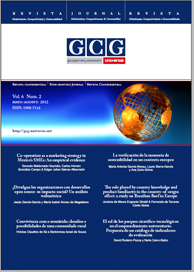
In the first article, Gonzalo Maldonado Guzmán (Universidad Autónoma de Aguascalientes, México), Carlos Hernan González Campo, and Edgar Julian Galvez Albarracín from Valle University (Colombia) analysed the collaboration between organisations as a marketing strategy that is increasingly gaining support in a highly competitive and globalising market, and which enables the participating small- and medium-size enterprises (SMEs) to obtain higher profits than they would by operating independently, as a result of the exchange of information, knowledge, and experience between employees. The article features an empirical analysis with a sample of 300 SMEs employing between 5 and 250 workers. The results indicate that cost reductions, financial performance, and innovation have significant, positive effects on inter-company collaborations.
The open source concept describes a software development methodology that facilitates free access to the source code, which has generated a broad, and in some cases, efficient and innovative ecosystem, freely accessible to the public, which at times reduces the software to a basic infrastructure product, and promotes the creation of value at a later phase in the chain. Jesús García García and María Isabel Alonso de Magdaleno from Oviedo University (Spain) identify the factors that enable this social responsibility to be communicated. To do so, they have conducted a webmetric study in which various relevant projects are analysed in search of successful communication indicators.
The objective of the next article, written by Ninicius Claudino de Sá and Bartolomeu Israel de Souza from the Federal University of Santa María and the Federal University of Paraíba (Brazil), respectively, is to determine the perception of leaders from a rural municipality located in the semi-arid Brazilian state of Paraíba, in order to identify their strengths and weaknesses. As a result, the authors point out the tremendous interest of leaders in improving the quality of life in the region, by optimising the use of natural resources and preventing environmental degradation. They also show immense concern for the rural youth, recommending greater investments in public policies related to education, leisure, and professional development.
According to professors María Antonia García-Benau, Ana Zorio Grima, from Valencia University (Spain), and Laura Sierra García from Pablo de Olavide University (Spain), external verification lends more credibility to CSR reports. Their research shows the results of an empirical study from 2005-2009 on the verification of 2,685 sustainability reports conducted by European companies. The results indicate that the decision to validate results depends on the size of the company, the sector, the year, and the country’s accounting system. Spain, with 33% of its reports substantiated, is the country which most often opts to verify its sustainability reports, establishing itself as a pioneer in the pursuit of higher quality in the social and environmental information published.
In the next article, professors Janaina de Moura Engracia Giraldi and Fernanda de Tavares Canto Guina from Sao Paulo University (Brazil) have endeavoured to quantify the influence of Brazil’s image on the attitudes of European consumers with respect to Brazilian beef, a phenomenon known as the country-of-origin effect. By conducting a survey in four European countries (Ireland, England, Germany, and France), the authors discovered low levels of knowledge about Brazilian beef, as well as minimal, though positive, country-of-origin effects. This effect is more positive in consumers with greater awareness of Brazil and more familiarity with Brazilian beef.
David Rodeiro Pazos from Santiago de Compostela University (Spain) and Nuria Calvo Babio from La Coruña University (Spain) have designed a conceptual framework for Science and Technology Parks as drivers of innovation and creators of entrepreneurial cultures on university campuses. Based on an analysis of the Spanish model, the authors have designed a strategic map that links the key characteristics of the Parks to their growth, and have proposed a “triple helix of entrepreneurship,” identifying those agents with the greatest interest in choosing a specific Park wherein to locate university spin-offs: entrepreneurs, investors, and universities.
Again, we would like to thank those who make the smooth operation of the magazine possible: the Advisory Council, the Editorial Board, the editors and associate editors, reviewers, authors, and especially the readers.
Editor in Chief